
Targeted support for the high street. But is it enough to drive growth?
The 2026 Autumn Budget is broadly supportive of smaller high-street occupiers, but its benefits for commercial property investment and SMEs generally are much more uneven.
The most significant measure is the expansion of business rates relief. However, there are important distinctions between retail, hospitality and leisure premises and the wider commercial property market.
1. Commercial property: the main changes
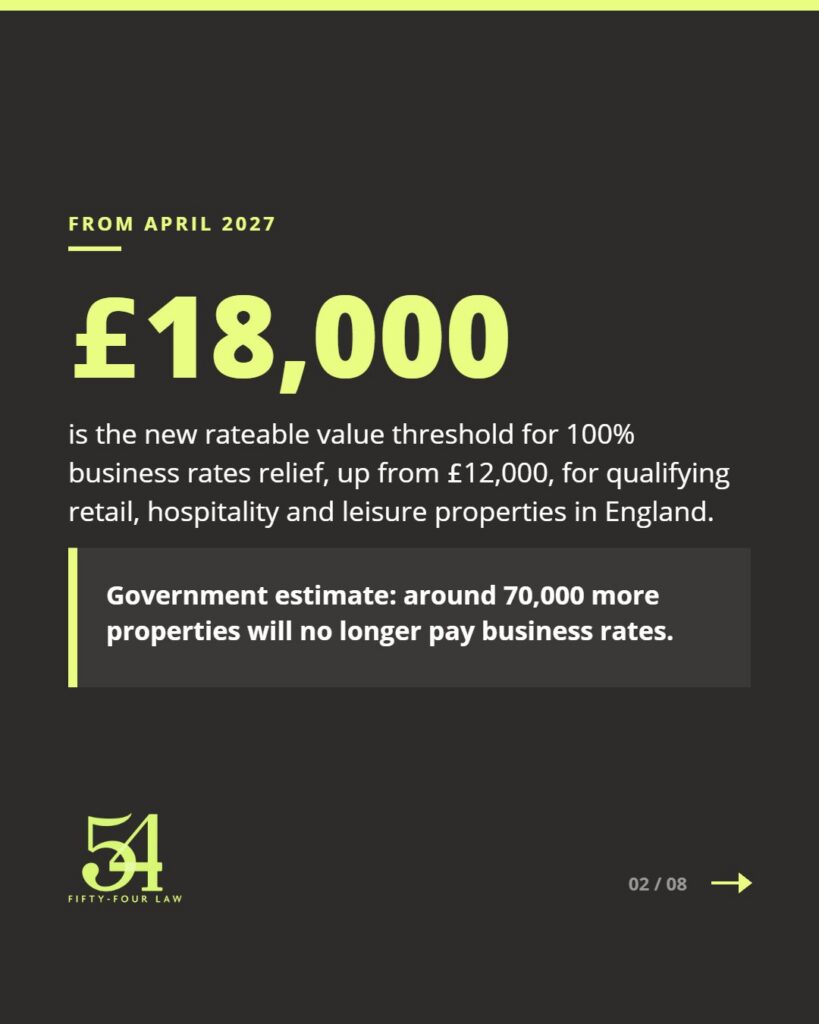
- 100% rates relief threshold: £18,000, up from £12,000 rateable value
- Additional properties exempt: 70,000 (government estimate)
Qualifying retail, hospitality and leisure properties in England, from April 2027.
The detailed measures include:
- Full relief: The rateable-value threshold increases from £12,000 to £18,000 for qualifying properties, subject to eligibility rules.
- Tapered relief: The upper threshold rises from £15,000 to £21,000.
- Rates freeze: Qualifying retail, hospitality and leisure properties will have their rates bills frozen in real terms, reduced or eliminated during 2027–28 and 2028–29.
- Pubs and music venues: Additional 20% relief from April 2027, taking the combined relief to 35% for eligible premises.
- Transitional protection: Extended for approximately 37,000 smaller ratepayers.
2. Likely effect on the commercial property market
| Sector | Potential effect |
|---|---|
| Small high-street retail | Positive for affordability and tenant viability |
| Restaurants, cafés and pubs | Positive on rates, but operating-cost pressures remain |
| Shopping centres | Indirect benefit where tenant finances improve |
| Offices | Limited direct benefit from the new rates relief |
| Industrial and logistics | No equivalent broad relief; larger high-value premises face a different rates regime |
| High-street landlords | Potential improvement in tenant demand, rent collection and vacancy levels |
The important commercial distinction is that a reduction in occupiers’ operating costs does not automatically translate into higher rents or capital values.
It may initially reduce insolvency risk, improve tenant covenant strength and support occupancy. Whether landlords ultimately capture any benefit through rental growth depends on local supply, demand and lease terms.
There is also a potential competitive advantage for smaller independent premises relative to some larger occupiers.
3. Impact on SMEs more generally
Beyond business rates, the picture is mixed.
| Budget measure | Likely business impact |
|---|---|
| Minimum wage increase of 3.9% | Higher payroll costs for labour-intensive SMEs |
| Fuel duty freeze | Some relief for transport, distribution and logistics |
| Electricity discount of 20–25% for eligible energy-intensive manufacturers | Significant potential saving for qualifying manufacturers |
| Small business procurement reforms | Potentially easier access to government contracts |
| Measures against late payment | Potential improvement in SME cash flow, dependent on implementation |
| Expanded tariff suspensions | Lower input costs for some manufacturers and importers |
The industrial electricity discount is scheduled to begin in April 2027, with backdated support for 2026–27. The broader SME reforms are partly administrative rather than immediate reductions in costs.
4. How businesses are responding
The early hospitality response is particularly revealing.
UKHospitality welcomed the rates changes as meaningful progress but continued to demand VAT reductions.
Other operators were much more critical. Restaurant owners cited rising employment costs, the absence of VAT reform and difficulties maintaining profitability even when turnover remains strong. Some expressed concern about further closures and reduced investment.
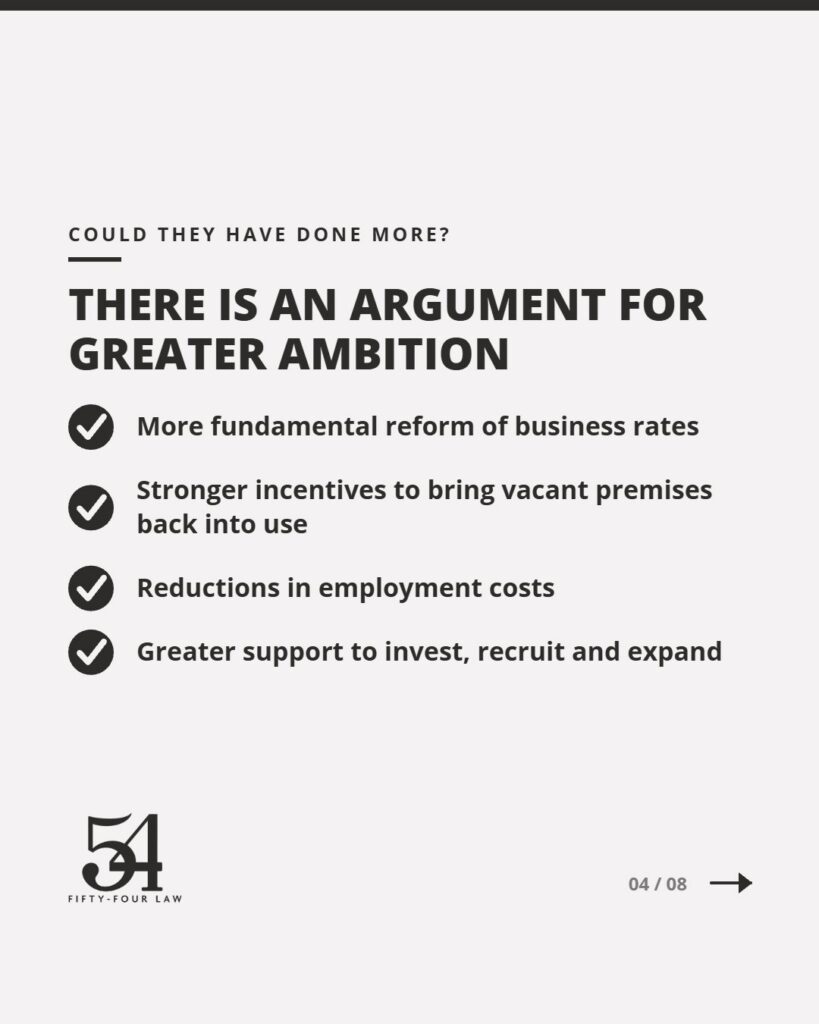
That exposes a limitation of the Budget: a reduction in property-related taxation may be insufficient where wages, employer National Insurance, energy, food and financing costs are simultaneously squeezing margins.
5. What about investment and property transactions?
My assessment of the likely secondary effects is:
- Leasing activity: Some improvement is plausible among smaller retail and hospitality occupiers as affordability improves.
- Investment yields: Limited immediate reason for significant repricing solely because of these measures. Interest rates, financing costs and rental growth remain critical.
- Development: Little in the rates package directly transforms the viability of new commercial developments.
- Vacant property: The government intends to examine whether rates reforms could encourage reoccupation, but that is not yet a substantive new incentive.
- Regional markets: Greater local retention of business rates could eventually strengthen incentives for councils to support commercial development, although the practical consequences will depend on the devolution framework.
Overall assessment
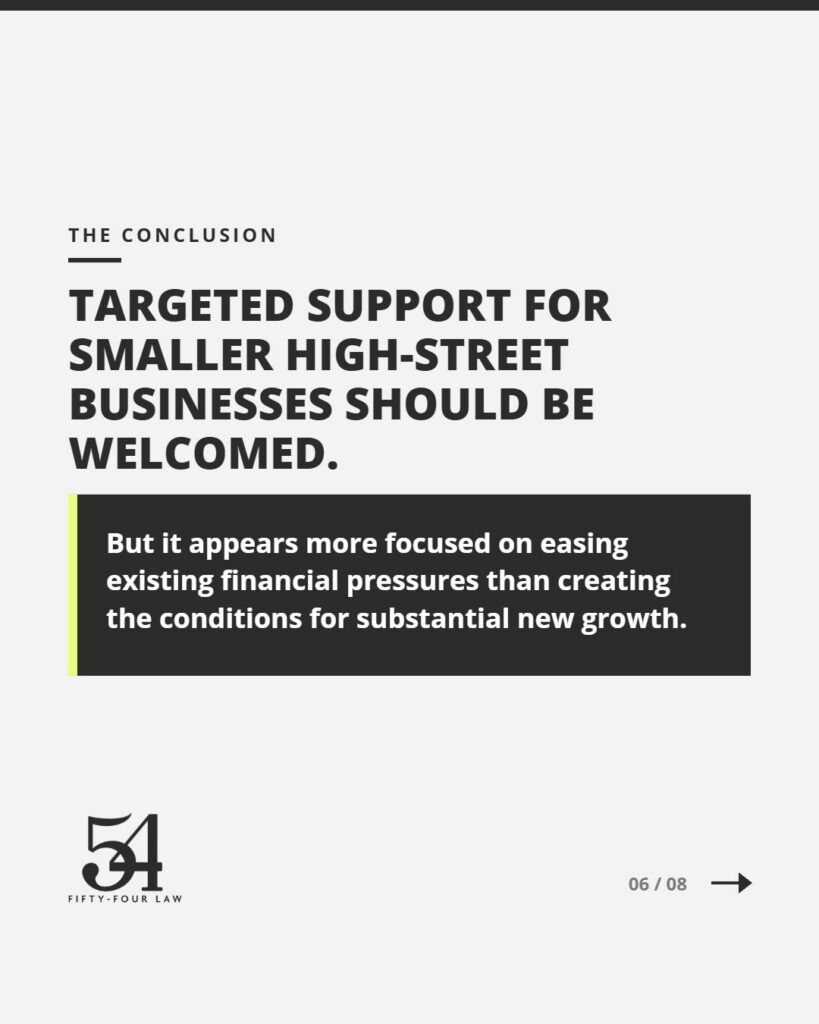
The Budget appears more focused on protecting existing businesses and reducing the risk of further high-street decline than stimulating a substantial new wave of commercial property investment.
For commercial property, the most credible near-term benefit is improved tenant affordability and potentially lower vacancy risk in qualifying sectors.
For SMEs, the benefit is uneven. Smaller high-street operators receive targeted support, while many other businesses continue to face substantial operating-cost pressures.
The key economic test is whether these measures generate additional investment, hiring and new business formation, rather than simply allowing existing businesses to absorb rising costs.
Sources: HM Treasury, Budget 2026 · Hospitality industry reaction (The Caterer)
Thinking about new premises? See our services for tenants, landlords and businesses buying or selling commercial property.
The carousel





General information only, not legal advice.